
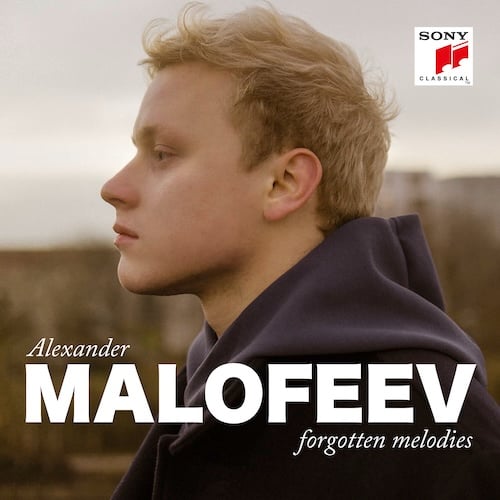
Gramophone review on “Forgotten Melodies” album
🔷 Gramophone / Alexander Malofeev: Forgotten Melodies
Those who’ve been following Alexander Malofeev’s impressive recitals live and online are likely to have anticipated this solo debut release from the 24-year-old pianist with bated breath. Encompassing more than two hours’ worth of music by four prominent Russian composers who emigrated and died in exile, this ambitious programme was worth the wait.
The opening salvo, Balakirev’s transcription of Glinka’s ‘The Lark’, has rarely sung out so ravishingly as in Malofeev’s hands. If the pianist’s seamless phrasing is more curvaceous than heel-clicking in four brief Glinka dances, the music can certainly take it. Next he presents the complete first set of Medtner’s Forgotten Melodies, which commences with the ‘Sonata reminiscenza’. Malofeev shapes the latter’s opening 16 bars at a hushed and steady gait that is closer to the composer’s tranquillo directive than the brisker and forceful con moto favoured by Boris Berezovsky and Geoffrey Tozer. Yet Malofeev’s seductive legatissimo touch doesn’t prepare one for the power and urgency he brings to the music’s agitato and allargando outbursts. His deliberately emphatic ‘Danza festiva’ strikingly differs from Marc-André Hamelin’s supple litheness (Hyperion, 10/98), while the dry wit of Hamelin’s ‘Danza rustica’ contrasts with Malofeev’s earthy and full-bodied approach. And for weightless cantabile phrasing that soars over the bar lines, check out the pianist’s flexibly poetic reading of the ‘Tale of the Elves’, Op 48 No 2.
Malofeev treats Rachmaninov’s C sharp minor Prelude, Op 3 No 2, as a mini-drama. He holds back the opening statement of the theme in a searching, hesitant manner, then builds the central section up to a relentlessly impassioned return of the theme. The posthumously published Fragments provide a quiet bridge into one of the most galvanic performances of Rachmaninov’s Second Sonata (here the revised 1931 version) that I’ve encountered anywhere. For all of Malofeev’s outsize dynamics, bomb-dropping bass accents and pulverising chords, he never bangs. Indeed, Sony’s sound really comes into its own here in regard to capturing the colourful richness of Malofeev’s sonority, although pedal noises are unusually prominent throughout this release. His expansive and texturally multidimensional traversals of the Op 3 Élégie, the composer’s transcription of his song ‘Lilacs’ and three selections from the Op 33 Études-tableaux will disprove the slightest notion that ‘Golden Age’ pianism is a thing of the past. The eighth Étude’s orchestral power and unassailable authority alone makes my point. Finally, the concluding Glazunov pieces receive their finest recorded interpretations since those in Stephen Coombs’s excellent Hyperion series. The annotations include an insightful conversation between Malofeev and Gramophone’s James Jolly. Needless to say, an auspicious debut.
Sony Classical
By Jed Distler, March 2026