
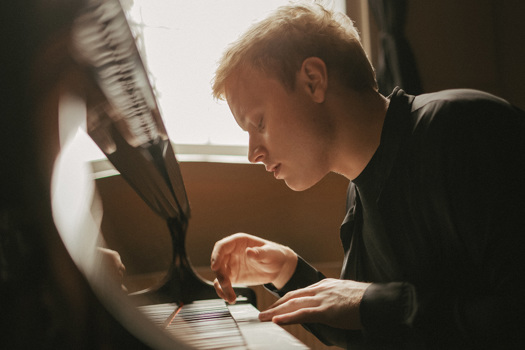
Alexander Malofeev introduces “Forgotten Melodies” (06.03.2026)
🔷 International Piano / Alexander Malofeev introduces his debut album for Sony Classical, which combines well-known and neglected works by four Russian composers close to his heart.
On my debut solo album for Sony Classical, I have combined music by four Russian composers who all grew up in Russia but died abroad. This is a project I have wanted to fulfil since childhood and I’m delighted to be able to make that dream a reality. The title of the album, ‘Forgotten Melodies’, is taken from Nikolay Medtner’s set of eight pieces, Op 38 – the first of three cycles he called Forgotten Melodies. This set of pieces was the kernel for the whole album and the rest of the programme grew outwards from it.
Medtner is one of my favourite composers. I first heard his music at the age of 10 or 11, when I started to play one of his Skazki (‘Tales’) and quickly became deeply interested in his musical language. With Medtner, from the moment you open a score, the music is fascinating. But it is not obvious. You can spend a couple of weeks practising a piece at home, and slowly it continues to reveal itself. You step away from it and go and do something else, but this music stays with you, gradually seeping into your consciousness. You go to sleep and it’s there in your dreams.
I deeply regret that Medtner’s music is so underestimated outside Russia. I can understand why Rachmaninov’s music is more popular, but Medtner’s Op 38 Forgotten Melodies is not only a masterpiece and perhaps his most accessible music, but for me it is one of the greatest works in all Russian music. Yet it is almost never performed complete. The opening piece, the ‘Sonata reminiscenza’ (by a distance the longest piece at around a quarter of an hour), is played quite a bit, but this set is rarely performed as a cycle and I think it needs to be. The best thing about this set is the way in which so many seeds for later pieces are found in the opening ‘Sonata reminiscenza’, ideas that Medtner goes on to explore and develop and transform in different ways.
“So much of the music on this album seems to me to be about an imaginary world”
I have played the ‘Sonata reminiscenza’ many times on its own – as lots of other pianists do – and there is no doubt that it works very well. But by going on to play the rest of the cycle you fully appreciate the range and potential of its ideas. As you continue through the set, you have this feeling of following Medtner’s process of invention and imagination, as he works out how to develop its primary ideas. In fact, you get the sense that the connections between the individual pieces might even have come before the ideas themselves. That’s why it seems so important to me to present the cycle as a whole. I wish more pianists would do this. Perhaps concert promoters don’t want it. Perhaps too much Medtner is off-putting. But we can only hope that more recordings and more advocacy will change this.
Rachmaninov is the most obvious companion to Medtner. The two composers were close friends and hugely admired one another. I have recorded the revised version of the Second Piano Sonata. I know that this revision has come in for some criticism, because he cut so much of the transitional material – and I do love both versions, the 1913 original and the 1931 revision. But with these cuts the musical shifts are much more sudden and abrupt, which for me makes this sonata closer in spirit to Medtner. In lots of Medtner the music can seem patchy, as if it is stitched together rather than being seamless – he often presents an idea and then explores it from a different angle. In the revised version of Rachmaninov’s Second Sonata, removing so much of the transitional material gives the same effect, as if the music is struggling to breathe.
Some of Rachmaninov’s music – I am thinking in particular of the Second Piano Concerto – is so smooth that it doesn’t really need an interpreter. When I play this Concerto it feels as if the best thing I can do is to not bother it and just let it flow. This is also the case with some of the Preludes and Études-tableaux. But, as someone who spends a lot of time practising and rehearsing and thinking and re-listening to music, Rachmaninov’s ultimate masterpieces are those that feel strangely unnatural – the Fourth Piano Concerto and the Third Symphony, even to some extent the Paganini Rhapsody. With these works it is as if the music struggles to develop. Of course, Rachmaninov knew how to develop his music, but in these pieces you get this sense of inner uncertainty and this feels to me part of Rachmaninov’s essence. It’s often said that the cuts to the Second Piano Sonata were intended to make the music more accessible, but to me they also make this music closer in spirit to the composer’s later works. Rachmaninov wasn’t always the best judge when it came to cutting his own works – those in the Third Piano Concerto are less successful and are rarely observed now – but I think of his relationship with his own music as being in a constant state of development. In fact, when I’m listening to Rachmaninov as a pianist, even if he is playing Chopin or Schumann, it feels like I am witnessing the process of creation. That’s exactly how I see this revision to the Second Sonata: it’s like the creative process is laid bare, and it’s fascinating. As a coupling for Medtner’s Forgotten Melodies, the revision feels more appropriate and more closely related. As with the Medtner, everywhere you turn there are interpretative choices to be made. I didn’t want the more familiar Rachmaninov to overshadow the Medtner, so it was important to place the Rachmaninov afterwards (on the second disc, for the physical album).
I preface the Medtner with five pieces by Mikhail Glinka. Growing up in Russia, pretty much the first music you hear is by Glinka – A Life for the Tsar (Ivan Susanin) and Ruslan and Lyudmila. He was the father of all the Russian music that followed, and to a seven-year-old it really felt like this is where music began. Yet so much of his other music is not really known, including his piano works. Nevertheless, opening with Glinka as the ‘Godfather’ of this album feels appropriate, and the connections both backwards to earlier European music and forwards to the other composers on the album are clear. So much Russian music stems from vocal music, and is tied closely to the Russian language and to folk music, and this is true of Glinka, even though his piano miniatures also owe a lot to John Field, who lived most of his adult life in Russia.
06.03.2026