
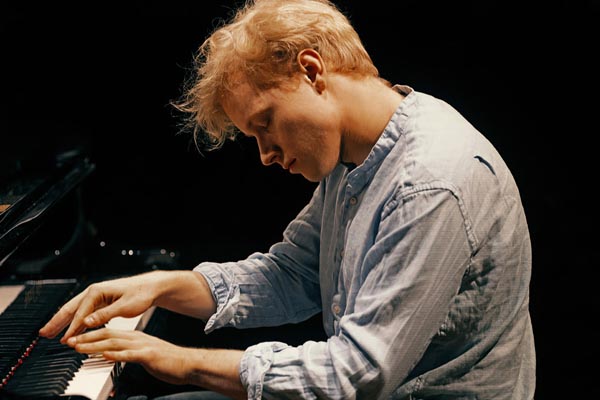
Reviews of the recital at the Salle Gaveau (23.01.2026)
🔷 Bachtrack.com / The shaman Alexander Malofeev stuns the Salle Gaveau in a programme of rare works.
The audience was not daunted by having to travel “From Scandinavia to Russia”, not deterred by Jean Sibelius, Einojuhani Rautavaara and Arthur Lourié, not discouraged by Igor Stravinsky’s Symphonies of Wind Instruments arranged for piano. Tonight the Salle Gaveau is not full to the last seat, but it is not far from it. Philippe Maillard, the private producer of this recital, did not think for a second about asking the young pianist, whom he was inviting for the third time, to choose an easier programme. He set to work to fill the hall, which, he told us, responded remarkably well in return. And the audience came! With a little imagination and will, this hall could become the Parisian Wigmore Hall…
Alexander Malofeev takes to the stage with a quick step that sends the panels of the black overshirt he wears as a jacket flying. Barely seated in front of his piano, he plays the five pieces that form The Trees op. 75 by Sibelius. Under his fingers flow colours, nuances, surges and inflections; an atmosphere takes hold that almost pushes into the background the kind of pianistic refinement associated with Guiomar Novaes or Josef Hofmann. Decidedly, this so-called ‘mauvaise musique’ is better than its reputation.
Malofeev takes his time, as he will do later in an astonishing way in the Valse op. 38 by Scriabin and, at the very end of his recital, in the Préludes fragiles op. 1 by Arthur Lourié. He knows how to elevate them to the ecstatic, suspended on a thread that never breaks, even when he dares to play pianissimos on the edge of silence. An unprecedented silence in the audience carries him and emboldens him to dare. The intimacy, sweetness, expressive warmth and magnetism of this pianist – whose tonal signature places him at the pinnacle of pianistic art – are enhanced by a Shigeru Kawai piano offering finesse, transparency and the brilliance of clear, well-defined basses, the noble metal of a great instrument from the 1920s, though it would have benefited from a visit from the tuner during the interval.
When Sibelius’s final piece, ‘The Spruce’, is heard, we encounter a melody that feels instantly familiar – a hallmark of minor masterpieces. Malofeev follows it with almost without pause with Grieg’s Holberg Suite. He relishes this stylisation of ancient dances, playing with seriousness, sensuality and a love of the instrument that calls to mind what the great American pianist William Kapell once said of Vladimir Horowitz: “If people understood what his tone meant, he would be banned from the keyboard.” Malofeev is there in every sound, every nuance, every articulation, oblivious to the world around him, dissolved in the music and in the piano, forming with them a holy trinity.
This programme is thought to lead us to Sonata No. 2 ‘Le Sermon de feu’ op. 64 by Rautavaara, whose modernity is part of a tradition other than that of the dodecaphonists and reaches a poetic and expressive ecstasy in the slow movement, after an introduction whose clusters are like the violent upheavals of the earth, fire and ice that meet in a cataclysm. A magnificent work that Malofeev shapes at measured tempi, heightening the sense of engulfment in the finale.
Prokofiev’s Sonata No. 2 opens the second part of the recital. Malofeev invests it with the strategy of a chess player in the way he organises the first movement and the finale: his fabulous piano technique allows him to free himself from all gravity in the explosions of this titanic music played without inertia. The pianist’s expressive and intellectual mobility allows him in the finale to give free rein to an almost mutinous spirit, which is very playful in the Prokofiev style. The composer’s provocative force remains intact.
After the Valse op. 38 by Scriabin stretched, suspended on an eloquent narrative thread, magnified by a pianistic refinement that fills the listener with joy, here are Stravinsky’s Symphonies of Wind Instruments in a rare transcription by Lourié. Rare, thin, almost silent music, with a very Bartókian touch. The audience remains in a state of shamanic stupor for long, lingering seconds. Something wonderful has just happened. A 24-year-old artist casts off the small demons that only yesterday might still have raised an eyebrow, and asserts himself among the firmament of today’s pianists.
By Alain Lompech, 28.01.2026
🔷 Diapason / Salle Gaveau, the triumph of Alexander Malofeev.
The twenty-four-year-old pianist put his exceptional means at the service of a fabulous programme in which Prokofiev and Stravinsky meet Sibelius, Rautavaraa and Lourié.
There are evenings when all the planets align: the Parisian acoustics most favourable to the piano; the instrument itself, a very beautiful Shigeru Kawai; a large and above all very attentive audience, kept captive by the almost incantatory power of a sorcerer over his audience. Finally, the programme: exciting, subtly arranged and off the beaten track. The result is one of the greatest concerts we have heard in recent years.
Refinement, vitality, bite
The recital opens with Sibelius’ The Trees, a collection of five miniatures approached more and more often, perhaps thanks to the impetus given by Leif Ove Andsnes’ landmark recording of the two jewels that conclude it – The Birch and The Spruce. Malofeev offers a performance of wonderful finesse, combined with the most luminous fluidity. He continues with Grieg’s Holberg Suite, as inspired by the Air, perfectly refined under his fingers, as by the Rigaudon, which is full of vitality and bite.
His ability to move from one state of mind to another diametrically opposed culminates first in Sonata No. 2 “Le Sermon de feu” (1970) by the Finnish Einojuhani Rautavaraa (1928–2016). This music of ice and sulphur, one moment calm then struck by furious bursts, summons in him a possessed interpreter, offering a stupefying demonstration of keyboard domination and spiritual assimilation.
Colossal technique and imagination
After the intermission, Prokofiev’s Sonata No. 2 shines, explodes and springs forth unhindered. The colossal technique of the Russian pianist – who has been living in Berlin for a few years – is so integrated and assimilated that we end up forgetting it. This subtle artist travels through the music with relish, bringing out motifs often ignored by virtuosos with a denser style. And what a fantasy in the conclusive Vivace! His conception of the Valse op. 38 by Scriabin: where many of his colleagues favour the effervescence,
Malofeev prefers to reveal the sensuality and lyricism.
Malofeev unearthed an astonishing arrangement by Arthur Lourié of Stravinsky’s Symphony of Wind Instruments. This black and white reduction accentuates the edges and spikes and, in some immobile passages, seems to make the Russian composer a distant cousin of the Satie of the mystical period. This revelation prepares the recreation of the Cinq préludes fragiles by the same Lourié — who was not even eighteen years old at the time of their composition. Again, the interpreter’s imagination is running at full speed. With a finely judged slowness – made possible by both impeccable control of sound and an exceptional beauty of tone, as well as pianissimo nuances poised on the edge of silence yet always eloquent – he caresses the piano, lending a fascinating expressive depth to these fleeting bubbles of feeling, scarcely uttered before they vanish, resonating like so many secret pacts.
The audience cheered the already accomplished young artist, who responded with three encores: Handel’s Minuet in G minor, beautifully pure, Prokofiev’s Toccata surging ruthlessly, before the shadowy serenity of Scriabin’s Prelude for the Left Hand concluded this exceptional evening. Alexander Malofeev reveals himself to be much more than a prodigious virtuoso: a strong personality with singular interpretative choices, and whose curiosity in terms of repertoire is a constant delight. A magician of the keyboard, who has definitively secured his place among the piano elite.
By Bertrand Boissard, 27.01.2026